Long-legged Waders
Description
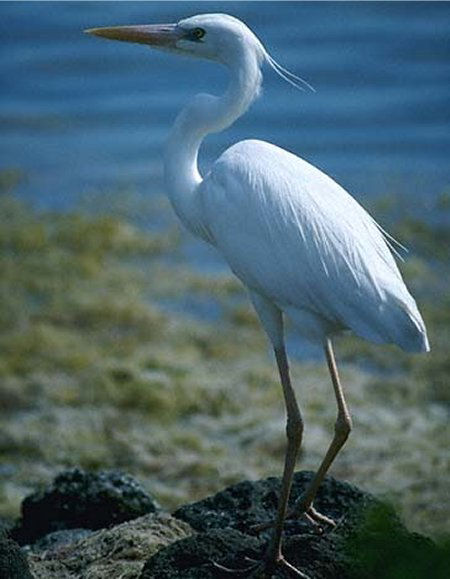
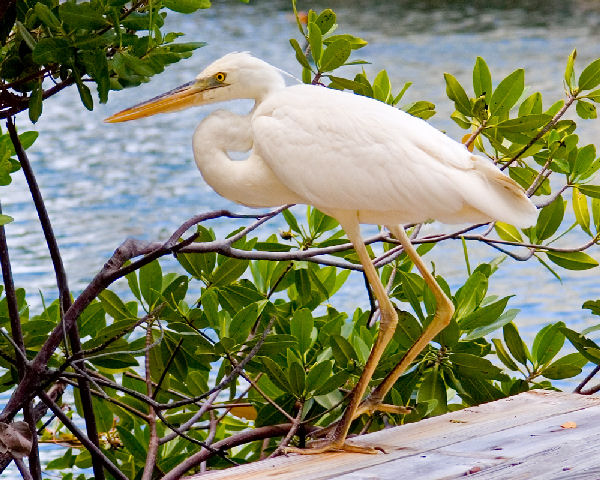
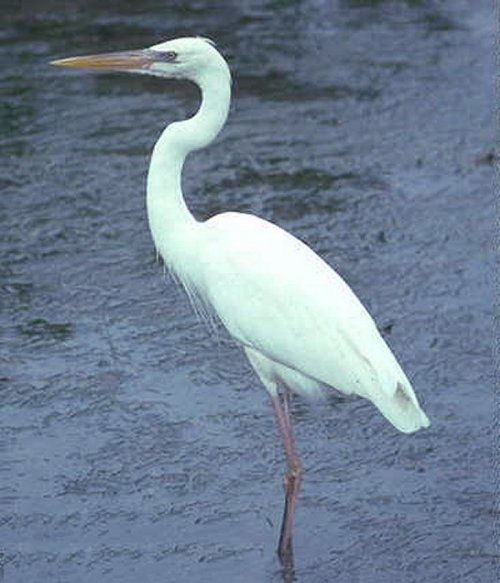
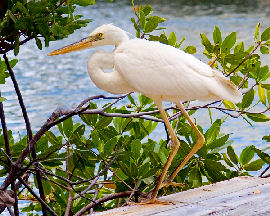
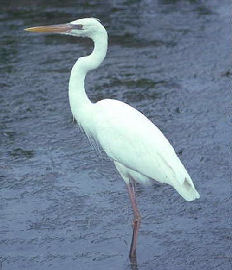
39-52" (99-132 cm). W. 5'10" (1.8 m). A common large, white heron with a orange to yellowish bill. The Great White Heron is presently considered a white form of the Great Blue Heron and includes intermediate forms between the Great Blue Heron and the Great White Heron. The Great White Heron differs from the Great Egret in being larger, with greenish-yellow rather than black legs.
Habitat
Great White Herons nest primarily on isolated mangrove islands in either loosely formed colonies, commonly with the blue morph; in colonies of other wading birds including Roseate Spoonbills, Reddish Egrets, Double-crested Cormorants, and Brown Pelicans; or as solitary pairs.
Voice
A harsh squawk.
Discussion
Great White Herons are a state-listed Species of Special Concern. In Florida Bay, the population recovered from only a few individuals in the mid-1930s to, in the 1960s, a stable population of between 800 to 900 birds in summer and 1,200 to 1,400 birds in winter. However, during that period, fluctuations occurred due to hurricane-related mortality. Surveys in the mid-1980s indicated population numbers similar to those of the 1960s. The Florida Bay birds are thought to comprise about 60% of the total Florida Keys population. In Florida Bay, between 450 and 600 nests were documented annually from 1987 to 1990. From aerial surveys in the late 1980s, covering about half of the lower Keys, 74 to 241 active nests have been observed during the peak December breeding period. Reproduction was monitored on 55 islands throughout Florida Bay from 1987 to 1990. Colony sizes and locations were similar among years. However, nesting success varied among colonies, and differences between regions were consistent for all years. The influence of people feeding herons accounts for some of the differences. A large portion of the birds nesting in the eastern region of the bay, the "panhandlers" fly to residential canals and shorelines of the mainline Keys where they supplement their diet with food from humans. Between 71 to 84% of nests produced at least 1 young in the eastern bay, compared with 28 to 63% for other regions of the bay. Approximately 1 young per active nest was produced at monitored sites in the Great White Heron Refuge in the lower Keys in 1989.