Snakes
Description
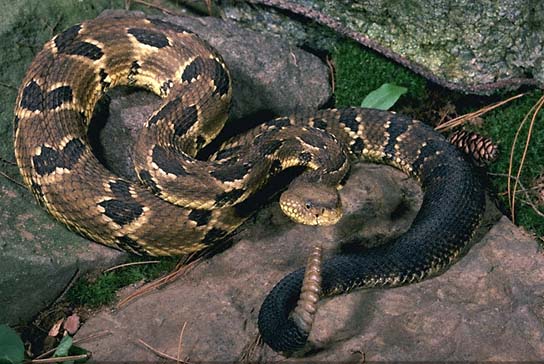
35-74 1/2" (88.9-189.2 cm). Northern forms range from yellow through brown or gray to black, with dark back and side blotches on front of body and blotches fused to form crossbands on rear of body. Head unmarked. Southern forms yellowish-, brownish- or pinkish-gray, with tan or reddish-brown back stripe dividing chevronlike crossbands; dark stripe behind eye. Both forms have black tail. Scales keeled, in 23-25 rows.

Warning
Rattlesnakes, Copperheads, and Cottonmouths belong to the pit viper family (Viperidae). These dangerous snakes have a heat-sensitive sensory organ on each side of the head that enables them to locate warm-blooded prey and strike accurately, even in the dark. The curved, hollow fangs are normally folded back along the jaw. When a pit viper strikes, the fangs rapidly swing forward and fill with venom as the mouth opens. The venom is a complex mixture of proteins that acts primarily on a victim's blood tissue. If you hear a rattlesnake shaking its rattle, back away. The snake is issuing a warning, and if the warning is ignored it may bite. Pit vipers are never safe to handle. Even dead ones can retain some neurological reflexes, and "road kills" have been known to bite. How to avoid and treat snakebites
Breeding
Mates in autumn and shortly after emergence from hibernation. Female gives birth every other year to 5-17 young, 10-13" (25-33 cm) long, late August to early October. Females mature in 4-5 years.
Habitat
Remote wooded hillsides with rock outcrops in the North; unsettled swampy areas, canebrake thickets, and floodplains in the South; sea level to 6,600' (2,000 m).
Range
Extreme sw. Maine south to n. Florida, west into se. Minnesota and c. Texas.
Discussion
Active April to October; in the daytime in spring and fall, at night during the summer. In northern areas, Timber Rattlesnakes congregate in large numbers about rocky den sites and may overwinter with rat snakes and Copperheads. Often encountered coiled up waiting for prey - squirrels, mice, chipmunks, small birds; when approached, remains motionless. Record longevity exceeds 30 years. Until recently, southern populations were recognized as C. h. atricaudatus, the Canebrake Rattlesnake.