Weasels, Skunks and Their Kin
Description
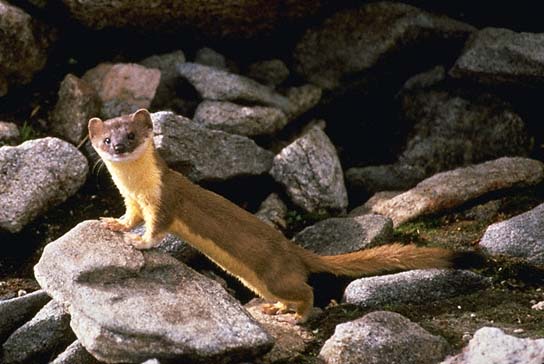
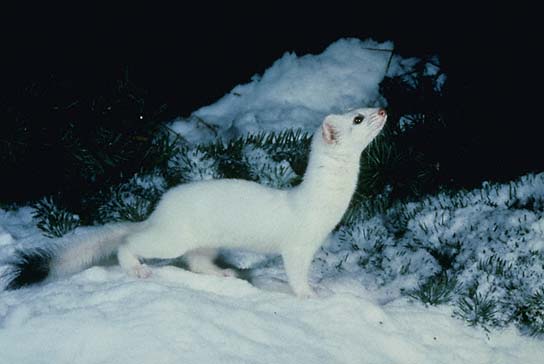
A long-bodied, short-legged animal. Brown above; white to deep yellow below. Tail long, often equal to head and body length; brown with black tip. Feet brownish. In Southwest, white on face. During winter in northern latitudes, fur entirely white (but often stained with yellow on hips) except for black tail tip. Male weighs about twice as much as female. L 11–22" (280–550 mm); T 3 1/8–6 3/8" (80–160 mm); HF 1 1/8–2" (29–51 mm); Wt 3–9 3/8 oz (85–267 g).
Similar Species
Short-tailed Weasel is smaller, with shorter tail and white feet. Black-footed Ferret is yellowish brown, with dark or black mask around eyes. Mink is larger and darker, with bushy tail and white spotting on throat and chin.
Breeding
Mates midsummer; development proceeds for about 15 days to blastula stage; implantation delayed until following spring; total gestation 205–314 days. 4–8 young born blind, nearly naked, in April or May; birth weight about 1/16 oz (3 g).
Sign
In deep snow: drag marks; holes where weasel
has plunged under snow. Cache of dead mice or voles under log or in
burrow.
Scat: Dark brown or black, long, slender and segmented,
often tapering at one end; frequently contains hair or bits of bone;
deposited on rocks, logs, or stumps.
Tracks: Hindprints 3/4" (18
mm) wide, 1" (25 mm) long or more, usually with only 4 of 5 toes
printing. Foreprints slightly wider than hindprints, but
approximately half as long. Hindfeet usually placed in or near
foreprints, but sometimes side by side, or with 1 slightly ahead.
Straddle 3" (75 mm). Stride varies as weasels run and bound, often
alternating long and short leaps: when carrying prey or stalking,
12" (300 mm); when running, 20" (500 mm).
Discussion
Like other weasels, the Long-tailed was once thought to be strictly nocturnal, but in fact is often out by day, since voles, a primary food item, are mainly diurnal. The most widespread carnivore in the Western Hemisphere, it preys largely on mice and voles, while also taking rabbits, chipmunks, shrews, rats, birds, and poultry, and the occasional insect or earthworm. When hunting, it follows a zigzag pattern, moving from burrow to burrow. It does not suck blood, contrary to myth, although it will often lap it from a wound. The Long-tailed Weasel will attack animals its own size and larger, but is very careful to attempt to take larger prey only when opportunity presents itself, or when smaller quarry is scarce. When attacking, the weasel rushes in toward the prey, grabs the victim at the base of the skull, and curls its body around it while grasping it with its forelimbs. It eats the head and thorax first, and caches the portion not eaten. Weasels occasionally go on killing sprees, as instinct dictates that they procure food when available and then store it. For this reason, a weasel in a chicken yard is disastrous. Like other weasels, the Long-tailed runs by a series of bounds, with its back humped at each bound and its tail trailing backward. It makes its dens in the abandoned burrows of other mammals, often chipmunks, and also ground squirrels, moles, or pocket gophers. Within the den it constructs a nest, primarily of hair from prey. The maternity den may also be in the burrow of another small mammal, or under a stump in a gully. The Long-tailed Weasel uses a variety of vocalizations: It may screech and squeal, utter a rapid trill, and purr when content. During the mating season, females give a reedy, twittering call. When the animal is alarmed, enraged, or excited by the mating urge, the anal glands release a powerful malodorous musk. A weasel may drag its rump on the ground, presumably to leave a scent that informs other weasels of its sex and perhaps even its identity. The Long-tailed Weasel male matures during its second summer, the female at three to four months of age. Only the female brings food to the young, which disperse at seven to eight weeks, when the males are already larger than their mother. In the northern part of its range, the Long-tailed Weasel turns white in winter. The time of the molt is governed by the length of daylight, and the change is gradual; weasels are piebald during transition. In the southern part of its range, within a 600-mile-wide (1,000-km-wide) transcontinental belt, some individuals molt to white, while others remain brown. In Pennsylvania, for instance, less than half of the weasels become white, and south of the Maryland-Pennsylvania border none do. The color change is evidently genetically determined: If a northern weasel is captured and taken south, it will still turn white in winter, while a southern weasel transported north will remain brown. Weasels are valuable in controlling populations of rodents, including rats. Hawks, owls, cats, foxes, and snakes prey upon the Long-tailed Weasel. This animal has also been taken by trappers, although its pelt is not considered especially valuable.