Turtles
Description
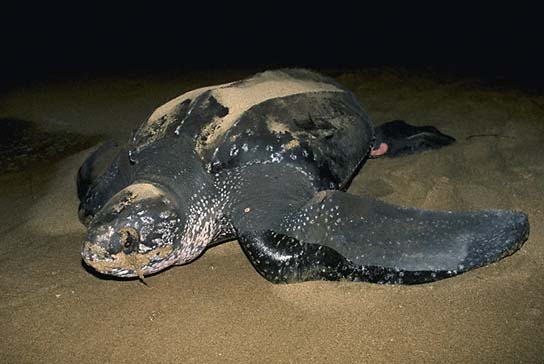
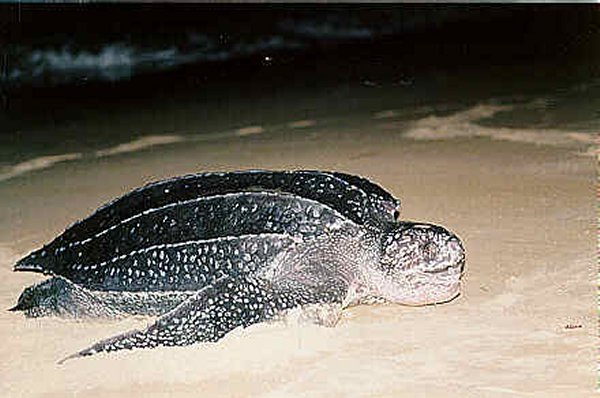
50-84" (127-213 cm). Largest living turtle. Adults weigh 600-1,600 lbs. (272-727 kg). Ocean-dwelling, with paddlelike, clawless limbs. Carapace elongated and triangular, slate to blue-black, covered with smooth skin (not scutes), with 7 prominent keels. Plastron white, with 5 ridges. Male has concave plastron and tail longer than hind limbs.
Endangered Status
The Leatherback is on the U.S. Endangered Species List. It is classified as endangered in Alaska, Alabama, California, Connecticut, Delaware, Florida, Georgia, Louisiana, Massachusetts, Maryland, Maine, Mississippi, North Carolina, New Hampshire, New Jersey, New York, Oregon, Rhode Island, South Carolina, Texas, Virginia, and Washington. This is one of the most critically endangered species in the world. Its flesh is not generally eaten, but the Leatherback was killed in the past for its oils, which are of cosmetic value. Its eggs are prized, and much of its decline can be attributed to the poaching of its eggs and the disturbance or destruction of its nesting grounds. Individual Leatherbacks sometimes mistake plastic bags and other litter for their favorite food, jellyfish, and ingest them, often with fatal results.
Subspecies
Atlantic (C. c. coriacea), warm
parts of Atlantic Ocean north to Newfoundland.
Pacific (D. c.
schlegelii), tropical waters to Pacific and Indian oceans, north
to British Columbia.
Range
Atlantic and Pacific oceans; chiefly in tropical waters but can be seen as far north as Newfoundland and British Columbia and even Alaska in summer.
Discussion
A powerful swimmer, it wanders great distances at sea. Long backward-projecting spines line its mouth and esophagus and help the Leatherback to swallow jellyfish, its main food. When captured, it flails at the assailant with its flippers, and emits groans and belches.