Turtles
Description
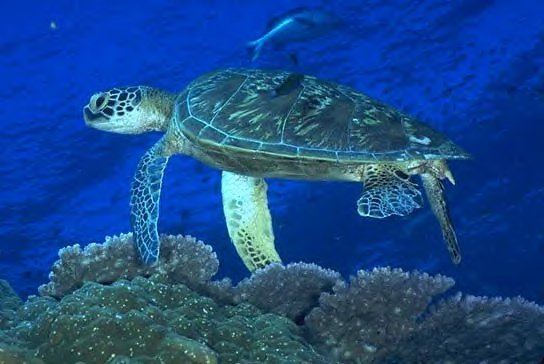
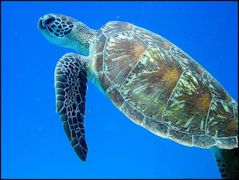
28-60 1/4" (71-153 cm). Ocean-dwelling, with paddlelike limbs. Carapace broad and oval-shaped, unkeeled; olive to dark brown and may have mottled or radiating pattern; 4 costal scutes, 1st not touching nuchal; 4 scutes on bridge. Plastron white or yellowish. Pair of prefrontal scales between eyes. Young have vertebral keel and pair of keels on plastron; flippers are edged in white. Male's tail is tipped with a flattened nail and extends well beyond shell.
Endangered Status
The Green Turtle is on the U.S. Endangered Species List. Breeding colony populations in Florida and on the Pacific coast of Mexico are classified as endangered. The Green Turtle is classified as threatened in all other parts of its range (Alabama, California, Connecticut, Delaware, Florida, Georgia, Louisiana, Maryland, Mississippi, North Carolina, New York, Oregon, South Carolina, Texas, Virginia, and Washington). Because its feeding and nesting grounds are well known and unchanging, this sea turtle is extremely vulnerable to human predation. Products derived from it - gourmet meat, flipper leather, cosmetic and cooking oils, and "turtle soup" calipee - are still in demand worldwide, although international trade of these products is now illegal.

Discussion
Hatchlings spend a "lost" year at sea; they drift with large floating mats of seaweed, feeding on small invertebrates and plants carried by the currents to no one knows where. A year later they reappear in shallow waters, where they graze on turtle grass and other marine plants until reaching maturity. With pinpoint accuracy they then return to the beaches where they hatched, having traveled perhaps 2,000 miles (3,200 km) from their pastures. In times past the Green Turtle provided fresh meat for seafarers. Today, its flesh and eggs are an important protein source for impoverished peoples in the tropics.