Chipmunks, Squirrels, and Prairie Dogs
Description
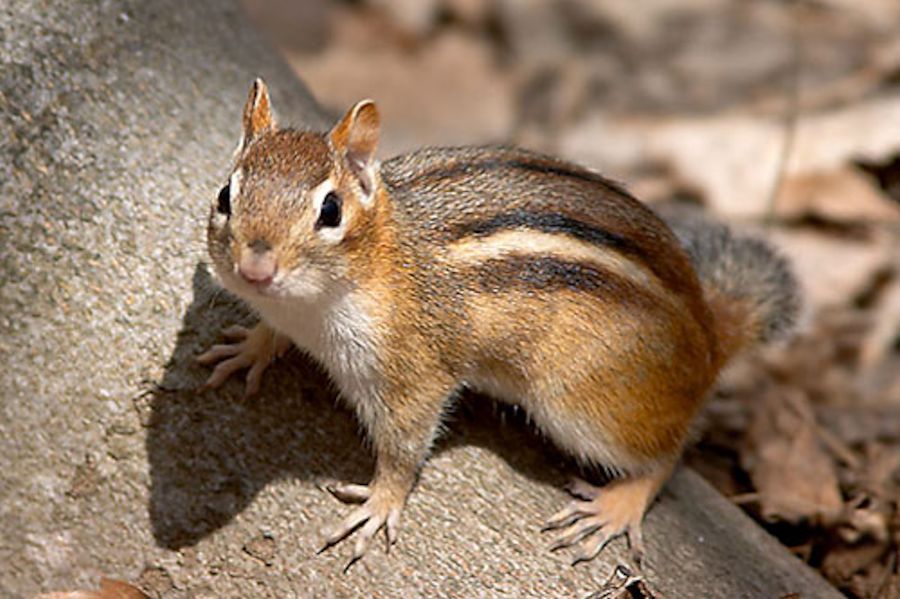
Reddish brown above; belly white. 1 white stripe bordered by 2 black stripes on sides; stripes end at rump. 2 white stripes on back much thinner than side stripes. Dark center stripe down back; pale facial stripes above and below eyes. Tail brown on tip, edged with black. Prominent ears. L 8 1/2–11 3/4" (215–299 mm); T 3 1/8–4 3/8" (78–113 mm); HF 1 1/4–1 1/2" (32–38 mm); Wt 2 1/4–5 oz (66–139 g).
Similar Species
Least Chipmunk has 4 white stripes of equal width on back.
Range
Southeastern Canada and ne U.S. east from North Dakota and e Oklahoma, and south to Mississippi, nw South Carolina, and Virginia.
Discussion
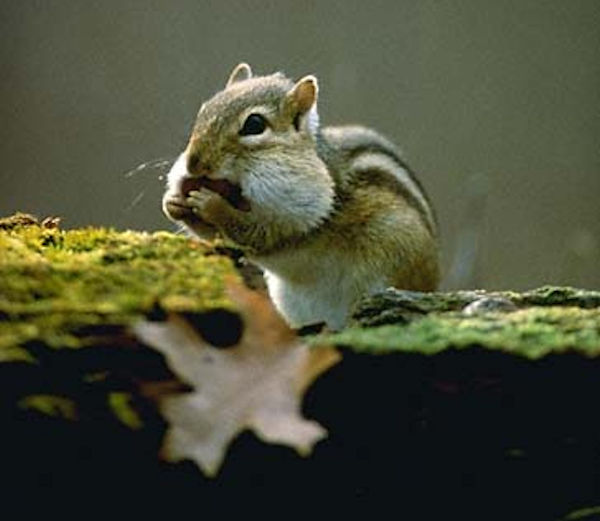
The Eastern Chipmunk hibernates from late fall to early spring, waking to eat every two weeks or so. Individuals may occasionally appear on the surface in the snow, especially in mild weather. Essentially a ground species, this pert chipmunk, like the gray and fox squirrels, often feeds on acorns and hickory nuts. It does not hesitate to climb large oak trees when acorns are ripe, and will also scale Corylus bushes to harvest hazelnuts. The cutting sounds it makes as it eats nuts can be heard for some distance. In addition to nuts, its diet includes seeds and other types of vegetation, some invertebrates such as slugs and snails, and small vertebrates, probably found as carrion. This species is single-minded in its food gathering, making trips from tree to storage burrow almost continuously. It was estimated that over three days one chipmunk stored a bushel of chestnuts, hickory nuts, and corn kernels. Burrows, consisting of single tunnels or more complex systems, are up to 10 feet (3 m) long and less than 3 feet (1 m) deep. They may include enlarged cavities for nests (made of pieces of leaves) and food caches, which are often large enough to last into the following spring and summer. Eastern Chipmunks of both sexes vocalize prominently, using one of two chattering calls: a trilling chip-chip-chip repeated very rapidly (about 130 trills per minute) and a lower-pitched, slower chuck . . . chuck . . . chuck. The Long-tailed Weasel is the Eastern Chipmunk’s major predator, but hawks, foxes, the Bobcat, and house cats also take their share.