Trouts and salmons
Description
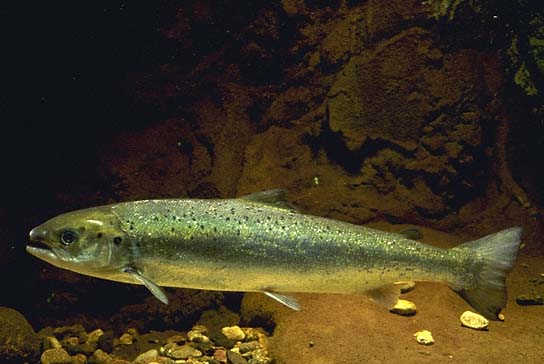
To 4'5" (1.3 m); 79 1/8 lbs (35.9 kg). Elongate, moderately compressed; adults brownish above, sides silvery, with numerous small, black spots, sometimes X-shaped, without halos, on head, body, and dorsal fin; males have red patches on sides; young specimens have about 11 dusky bars. Head large, depth about one-fifth length; maxilla reaches past eye; lower jaw upward-hooked in breeding males. Pectoral fins inserted well below axis of body; dorsal fin short-based, at midpoint of body; adipose fin present; caudal fin slightly forked or emarginate.
Endangered Status
The Atlantic Salmon is on the U.S. Endangered Species List. The Atlantic Salmon population known "the Gulf of Maine distinct population segment" is classified as endangered. This includes naturally reproducing wild populations and river-specific hatchery populations found north of and including tributaries of the lower Kennebec River to, but not including, the mouth of the St. Croix River at the U.S.-Canada border. Overfishing, disease, and the introduction of hatchery fishes plague efforts to save the Gulf of Maine salmon, the last known naturally reproducing wild Atlantic Salmon population in the U.S. Under the Endangered Species Act it is now illegal to take salmon from any of the population's designated waterways. Three diseases affecting these fish have been identified and are being studied. Additionally, the escape of hatchery-bred fishes into the wild salmon's range is being looked into. A group of interested parties, including officials of the state of Maine, Native American groups, and conservation organizations, is drafting a plan to save this valuable resource from extinction.
Habitat
Coastal waters; freshwater streams and lakes.
Range
Native in N. Atlantic from Arctic Circle, N. Quebec south to Delaware River; Lake Ontario. Landlocked populations in several New England states.
Discussion
This anadromous species spawns in the fall in high gradient streams over gravel. After spawning, the fish are weak and emaciated but do not necessarily die like some other salmonid species. The Atlantic Salmon is a well-known and highly valued food and game fish. Specimens as large as 40 to 50 lbs (18.1 to 22.7 kg) are unusual in the Atlantic; most weigh much less.